

African Studies Graduate School
Annex III, 4th & College Streets, NW Washington, DC 20059
Phone Number
(202) 238-2327
Email Address
AFST 309: Adv Sem in Lang Lit and Arts
Annex III, 4th & College Streets, NW Washington, DC 20059
(202) 238-2327
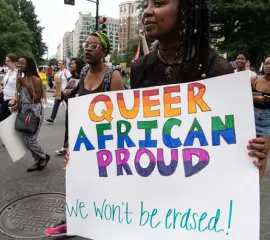
The political conditions shaping queer life in Africa reflect the influence of legal and administrative systems carried over from colonial governance as well as the ongoing policies and practices of contemporary states.

Legal frameworks inherited from European rule continue to exert powerful influence; today, nearly half the countries on the continent criminalize consensual same-sex relationships, with penalties ranging from long prison terms to the death penalty in some regions, including some northern states of Nigeria, Mauritania, Sudan and Somalia (Amnesty International 2023).
In the present day, homophobia and transphobia are further weaponized by political and religious leaders, who portray LGBTQ+ visibility as proof of Western imperialism. By framing queer rights as threats to cultural sovereignty, these leaders ignite public anxieties and reinforce exclusionary ideas about what it means to belong.
Despite these daunting circumstances, there have been important positive shifts. A handful of countries, including Angola, Mozambique, Botswana, and South Africa, have moved toward decriminalization, and South Africa has enacted some of the continent’s most progressive legal protections, including constitutional guarantees and marriage equality (Human Rights Watch 2023; Kollman & Waites 2009). Nevertheless, even where laws have changed, a substantial gap remains between legal rights and social attitudes. Public opinion often lags behind, producing tension between nominal protections and the actual lived realities of LGBTQ+ Africans. Members of the community continue to experience violence, verbal harassment, and both physical and sexual assault.